Design Case StudyUX & Product Design · iOS · Longevity
London Health
A digital health startup helping people live longer, healthier lives through everyday habits — without being overwhelming, intrusive or misleading.
Habit FormationLongevityDigital HealthiOS
30
Day habit window
5
Habit categories
19
Longevity habits
6
Screens designed
01 — Research & Insights
Start With Insights
Before designing anything, ten sprint questions framed the problem space, covering the user, the product, the experience over time and the principles that will govern every decision.
Working assumption
London Health is a digital health venture. It shares the club infrastructure (members, physical spaces, health data) but targets a broader longevity-focused audience beyond active gym-goers.
Primary research question
How might we help a London Health member build one sustainable health habit in their first 30 days — through guided support that feels personal, not prescriptive?
1
One thing at a time
Every screen has one job. Every nudge has one message. Every insight surfaces one action. Complexity is hidden, not removed — but the member never feels it. Applies to onboarding, check-ins, progress, and celebrations equally.
2
Progress over perfection
The product celebrates consistency, not streaks. Missing a day is data, not failure. The design language — copy, colour, iconography — always reframes setbacks as part of the journey. This principle governs the setback moment more than any other.
3
Honest over optimistic
The product never overclaims. Insights are qualified, data is contextualised, and recommendations are proportional to evidence. Trust is built through restraint — saying less, more accurately, is always the right call.
Sprint questions
What do we need to understand before we design? Ten questions frame the problem space.
Q1 — User & Behaviour
Who is the primary member we are designing for — and what is their current relationship with their health?
Commit to one ICP early. Maya A. — The Motivated but Inconsistent. 38, Marketing Manager. Broad enough to design for, specific enough to make decisions against. Most gym members fall here. Designing for the edges risks missing the majority.
Q2 — User & Behaviour
What are the 3–5 key moments in a member's health journey where the product can add most value?
Joining — the first 24 hours. Building — days 2 to 14. Setback — first missed day or week. Progress — day 30 check-in. Milestone — day 30 and beyond.
Q3 — User & Behaviour
What does "genuinely helpful" look like vs. overwhelming or intrusive — in the context of health data?
The test: "Would a knowledgeable, caring friend say this — or would it feel like a notification from an insurance company?" If it's the latter, redesign it.
Q4 — User & Behaviour
What habits have the strongest evidence for longevity — and which are actionable within a club or app context?
Draw from Blue Zones (Dan Buettner) and Blueprint (Bryan Johnson). 19 habits across 5 categories. Blue Zones habits suit Maya and Daniel. Blueprint habits suit James. Start with Blue Zones principles, layer in Blueprint-style depth.
Q5 — Product & Experience
What data does London Health have access to — and what should it ask members to provide?
Day 1 minimum: health goal, activity level, one habit, check-in time, age range. Earned over time: sleep, mood, nutrition opt-in. Out of scope v1: clinical/GP data, wearables, macros.
Q6 — Product & Experience
How does the experience build trust over time — and what prevents false confidence or misinterpretation?
Consistency, transparency, honesty, flexibility, earned insights. Qualified language: "Based on your recent activity..." not "You will...". Trends not single data points. Explicit scope limits.
Q7 — Product & Experience
How does this experience fit within the broader London Health app — and what does it not do?
In scope v1: onboarding, daily check-in, progress visualisation, setback state, 30-day milestone. Out of scope v1: GP referrals, wearables, nutrition tracking, social comparison, multi-market localisation.
Q8 — Product & Experience
How does the experience evolve from day 1 to day 30 to month 6 — and what keeps members returning?
Day 1 onboarding → Days 2–7 first streak → Day 14 setback reframe → Day 30 milestone → Month 6 compound/longevity narrative. The arc must feel like progress, not a treadmill.
Q9 — Design & Delivery
What is the minimum viable happy path — and which screen deserves pixel-precise UI?
Screens 4 + 5: Daily check-in + progress view. Day 7 active streak vs Day 14 setback — same layout, different emotional tone. Shows Conversational UX + Data Viz + craft in one surface.
Q10 — Design & Delivery
What are the 2–3 design principles that will govern every decision in this challenge?
1. One thing at a time. 2. Progress over perfection. 3. Honest over optimistic. These three are your defence in the panel Q&A. Every design decision should trace back to one of them.
Who are we designing for?
Five personas across the member spectrum. Maya is the primary ICP — the largest and most designable audience.
MA
Primary ICP
Maya A.
The Motivated but Inconsistent — 38, Marketing Manager
GoalBuild sustainable habits that compound over time — not a dramatic transformation, just consistent progress.
MotivationWants to feel in control of her health. Interested in longevity after a parent's health scare. Values evidence over trend.
NeedsSimple, structured guidance. Progress she can see. A product that meets her where she is, not where it thinks she should be.
Pain pointsStarts strong, loses momentum after 2–3 weeks. Overwhelmed by data. Feels guilty rather than motivated when she misses a day.
GoalExtend healthspan, not just lifespan. Interested in biometrics, VO2 max, biological age.
MotivationFollows longevity science (Peter Attia, Bryan Johnson). Wants to measure and optimise everything.
NeedsRich data, trends over time, integration with wearables. Wants to see the science behind recommendations.
Pain pointsExisting apps feel shallow. Can't connect gym data with sleep, nutrition, and recovery in one place.
RelationshipTrains 4x/week. Uses Apple Watch and Oura Ring. High-value, at-risk of switching clubs for better tech.
SC
Sandra C.
The Life Transitioner — 52, HR Director
GoalRebuild a health routine after a period of neglect — children leaving home, career shift, menopause.
MotivationMotivated by a specific life milestone. Wants to feel like herself again. Community matters.
NeedsLow-intimidation entry point. Human warmth, not clinical dashboards. Celebrates small wins.
Pain pointsFeels behind. Doesn't know where to start. Anxious about data that shows how far she's fallen.
RelationshipNew or returning member. Drawn to classes and swimming. High emotional investment if she finds her rhythm.
DP
Daniel P.
The Social Mover — 31, Creative Director
GoalStay active, feel good, keep up with friends. Health is important but not an obsession.
MotivationDriven by enjoyment and social connection. More likely to go if a friend is going. Responds to streaks and challenges.
NeedsFun, low-effort engagement. Social nudges. Variety in activity suggestions.
Pain pointsDrops off when life gets busy. Health apps feel like homework. Doesn't connect daily habits to long-term outcomes.
RelationshipMember 2–3x/week. High class attendance. Likely to refer friends. Engagement drops if no social hook.
PK
Priya K.
The Longevity Convert — 41, GP / Healthcare Professional
GoalModel the healthy behaviours she recommends to patients. Deeply motivated by longevity science.
MotivationSees the long-term consequences of poor habits daily. Personally committed to prevention over cure.
NeedsClinically credible content. No pseudoscience. Wants to trust the source of recommendations.
Pain pointsFrustrated by wellness apps that overstate claims. Time-poor. Needs a product that respects her intelligence.
RelationshipTrains 3x/week, mostly early mornings before clinic. High retention potential — if the product earns her trust, she becomes an advocate who recommends it to patients.
Where Are The Blue Zones?
Five communities where people routinely live past 100. The research foundation for the longevity habit library.
Loma Linda, California
Seventh-day Adventist community. Sabbath rest. Plant-based diet. Strong social bonds within faith network.
Nicoya, Costa Rica
Plan de vida (life plan). Strong faith community. Physical work into old age. Water rich in calcium and magnesium.
Sardinia, Italy
Steep terrain as natural exercise. Strong family bonds. Red wine in moderation. Pecorino cheese, flat bread.
Icaria, Greece
Afternoon naps. Mediterranean diet. Daily herb teas. Tight-knit community with low stress.
Okinawa, Japan
Ikigai (reason to wake up). Moai social groups. Plant-heavy diet. Hara hachi bu — stop at 80% full.
Longevity habit sources
Two sources. 19 habits consolidated across five categories with club and app context for each.
Area
Blue Zones principle
Behaviours & habits
Blueprint principle
Behaviours & habits
Movement
Move naturally — embed activity into daily life, not a gym routine
Walking, gardening, manual tasks, dancing. Activity is environmental, not structured.
club: classesapp: step goals
Exercise as a non-negotiable — 6 hrs/week, structured and measurable
Strength, cardio, flexibility, balance. Even 20 min/day counts. Track and progress over time.
Rest and rhythm — sleep as a cultural norm, not a sacrifice
Afternoon naps. Regular wake/sleep times. Low stress before bed.
app: sleep tracking
Sleep is the world's #1 longevity drug — build life systems around it
8 hrs target. Consistent schedule. No screens before bed. HRV and sleep quality tracked nightly.
app: sleep score
Purpose
Have a reason to wake up — ikigai (Okinawa) or plan de vida (Nicoya)
Defined personal purpose. Contribution to family and community. Feeling needed into old age.
app: goal setting
Don't Die as a conscious daily mission — survival as active intention
Daily intention setting. Treating health as a priority. Mission-driven decision making.
app: daily check-in
Stress
Downshift — daily routines that shed stress naturally
Prayer, naps, happy hour. Stress is actively discharged, not managed.
app: mindfulness
Emotional regulation as a measurable health behaviour
Meditation, HRV monitoring, avoiding cortisol spikes. Happiness as a biochemical outcome.
app: stress score
Community
Belong — faith, tribe, social circle all linked to longevity
Community gatherings, moai social groups (Okinawa), face-to-face connection.
club: classes, events
Love and be loved — family and friendship as core protocol
Intentional time with family. Community events. Social accountability for habits.
club: group training
Family
Put loved ones first — family structure as a health intervention
Live near family. Committed relationships. Family meals as daily ritual.
club: family membership
Family as motivation and accountability
Health goals shared with family. Children as reason to optimise longevity. Generational thinking.
app: shared goals
Measurement
Not explicit — longevity is environmental, not tracked
No wearables. Health emerges from context and culture, not dashboards.
app: qualitative check-in
Measure everything — biological age, biomarkers, performance data
Blood panels, VO2 max, HRV, body composition. Track trends weekly. Use data to make decisions.
app: health dashboard
Design implication: Blue Zones habits are low-friction and social — they suit Maya (primary ICP) and Daniel. Blueprint habits are data-rich and structured — they suit James. Start with Blue Zones principles (natural, community, purposeful) and layer in Blueprint-style tracking for members who want more depth.
Trust Framework
How trust is built
Framing question
How does the experience build trust over time — and what prevents false confidence or misinterpretation?
How trust is built
Consistency
The product behaves predictably. Members know what to expect from check-ins, nudges and data displays. No surprises.
Transparency
Be clear about what data is being used and why. Explain recommendations in plain language. Never hide methodology behind optimism.
Honesty
"Based on your last 7 days" is more trustworthy than "You're on track to live 10% longer." Confidence must be proportional to evidence. Don't overclaim.
Progress
Show members that their data is working for them, not just being collected. Insights must feel earned, not algorithmic.
Avoid False Confidence
Language
Use qualifiers: "Based on your recent activity…" not "You will…" Avoid absolute health claims.
Data
Show trends, not single data points. One good night's sleep doesn't mean full recovery. Context matters.
Scope
Be explicit that London Health is a habit and wellness guide, not a medical tool. Signpost professional support where appropriate.
Design
Avoid gamification that rewards volume over quality. Badges for logging 10 workouts can create false confidence if quality was poor.
02 — UX & Insights
From problem to opportunity
The experience mapped across time — five key moments in the 30-day arc, a clear happy path, and the wireframe decisions behind each screen.
30-day journey map
What a member feels, needs and does at each critical moment.
Stage 01
Joining
Day 1
Feel
Motivated, slightly anxious
Need
A clear, welcoming start — not a form
Do
Set one goal, pick one habit, choose a check-in time
Stage 02
Building
Days 2–7
Feel
Engaged, looking for proof it's working
Need
Daily reinforcement without pressure
Do
Complete daily check-in, see first streak forming
Stage 03
Setback
Day 14
Feel
Guilty, close to quitting
Need
Empathy, not guilt — a reframe not a reset
Do
Re-engage via a low-friction recovery prompt
Stage 04
Milestone
Day 30
Feel
Proud, curious about what's next
Need
Meaningful celebration + a clear next step
Do
Review 30-day arc, unlock next habit or deeper goal
Stage 05
Compound progress
Month 6
Feel
Transformed, confident
Need
The bigger picture — how habits connect to longevity
Do
View health arc across multiple habits, share progress
Design implication: Moment 3 (setback) is the most underdesigned moment in most health apps. Getting this right is a differentiator.
Lo-fi wireframes — happy path
6 screens. Thinking made visible — UX logic and decision rationale, not polish.
Screen 01
Welcome & goal setting
One choice, not a form. Selected goal filters habit options on screen 2. Step indicator builds momentum. No back button — forward only.
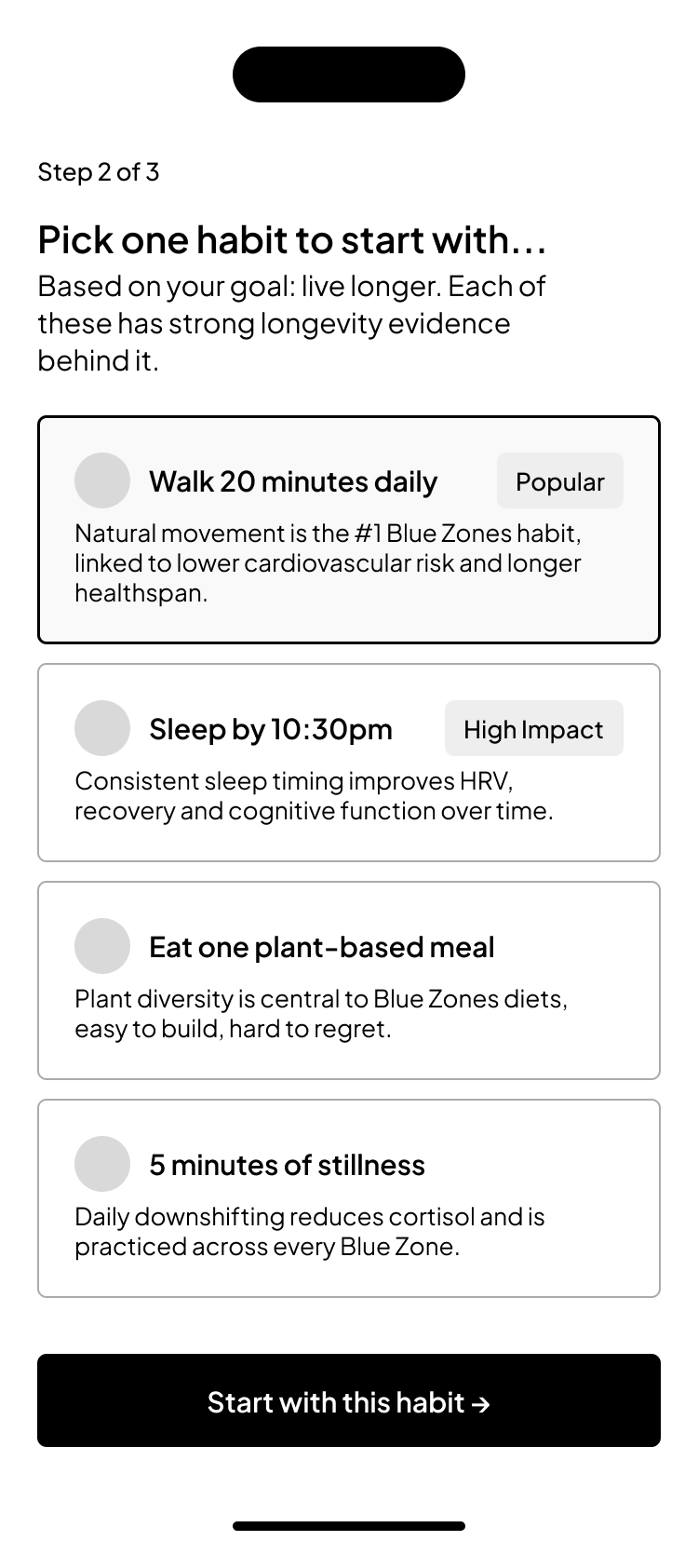
Screen 02
Habit selection
Curated shortlist only. Filtered by goal from screen 1. Evidence rationale on every card. First option selected by default — lowest friction path.
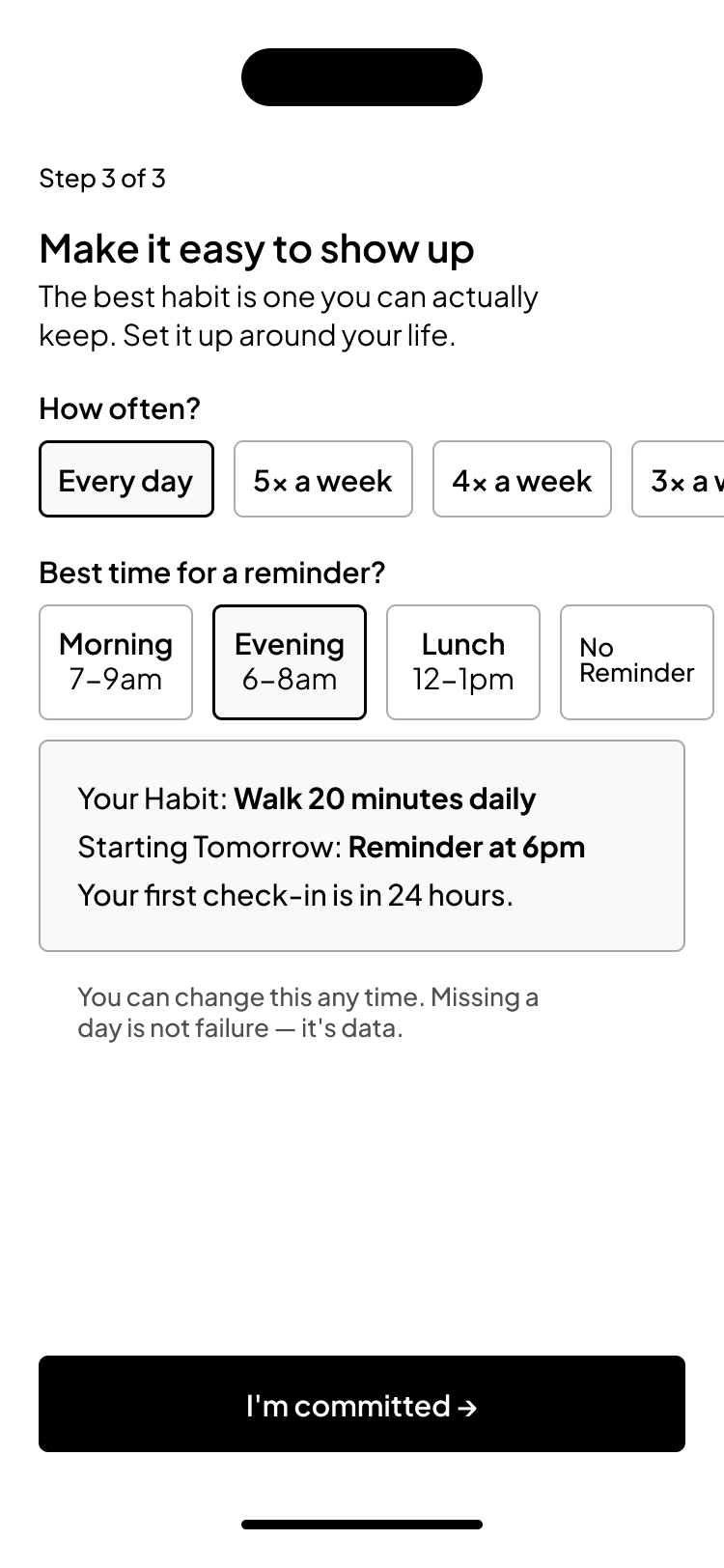
Screen 03
Commitment
A pact, not a settings screen. Two decisions only. Pact box confirms the full commitment back to the member. Reassurance copy prevents anxiety before they've even started.
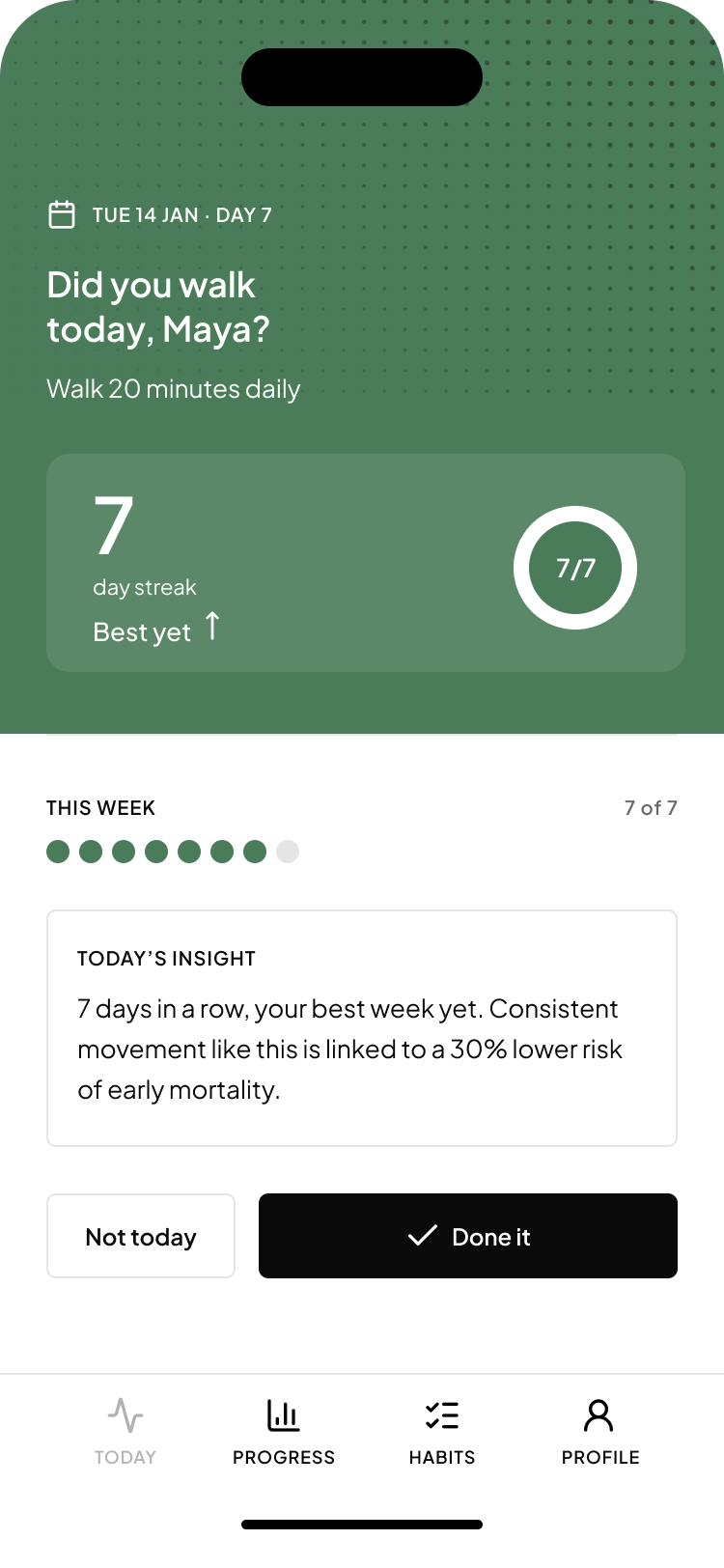
Screen 04
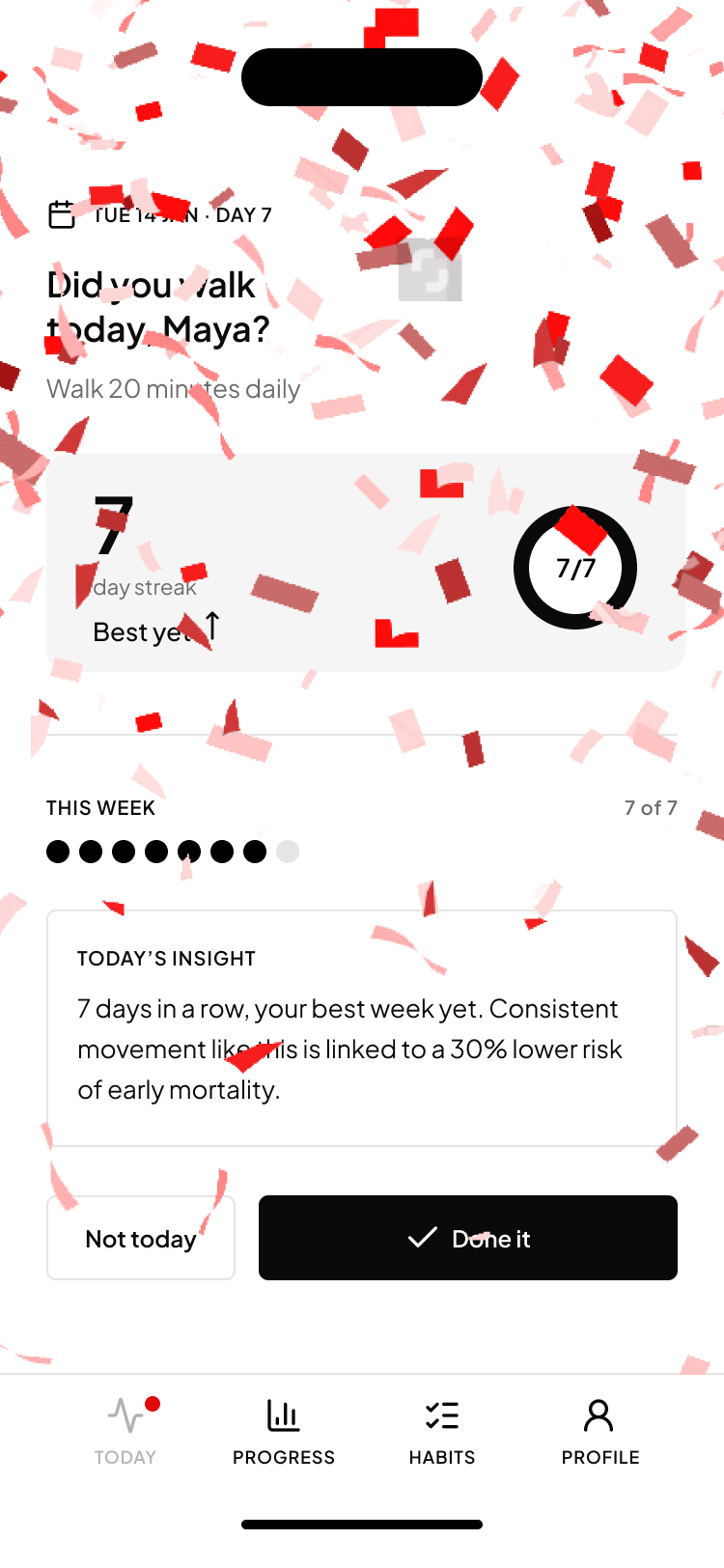
Daily check-in — Day 7
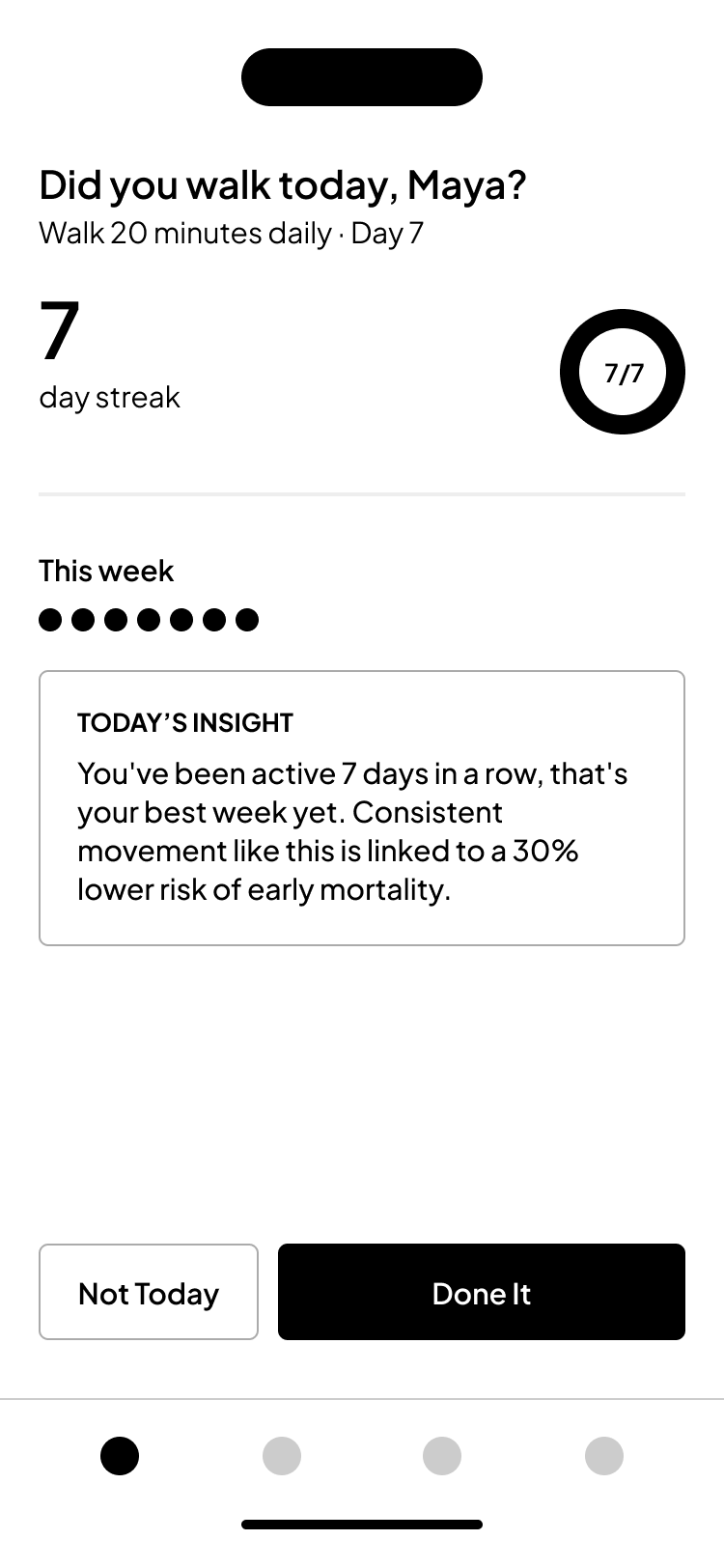
"Not today" visible but de-emphasised. Personalised greeting. Ring = full. Dots = 7-day arc. Insight is earned, qualified with evidence.
Screen 05
Daily check-in — Day 14
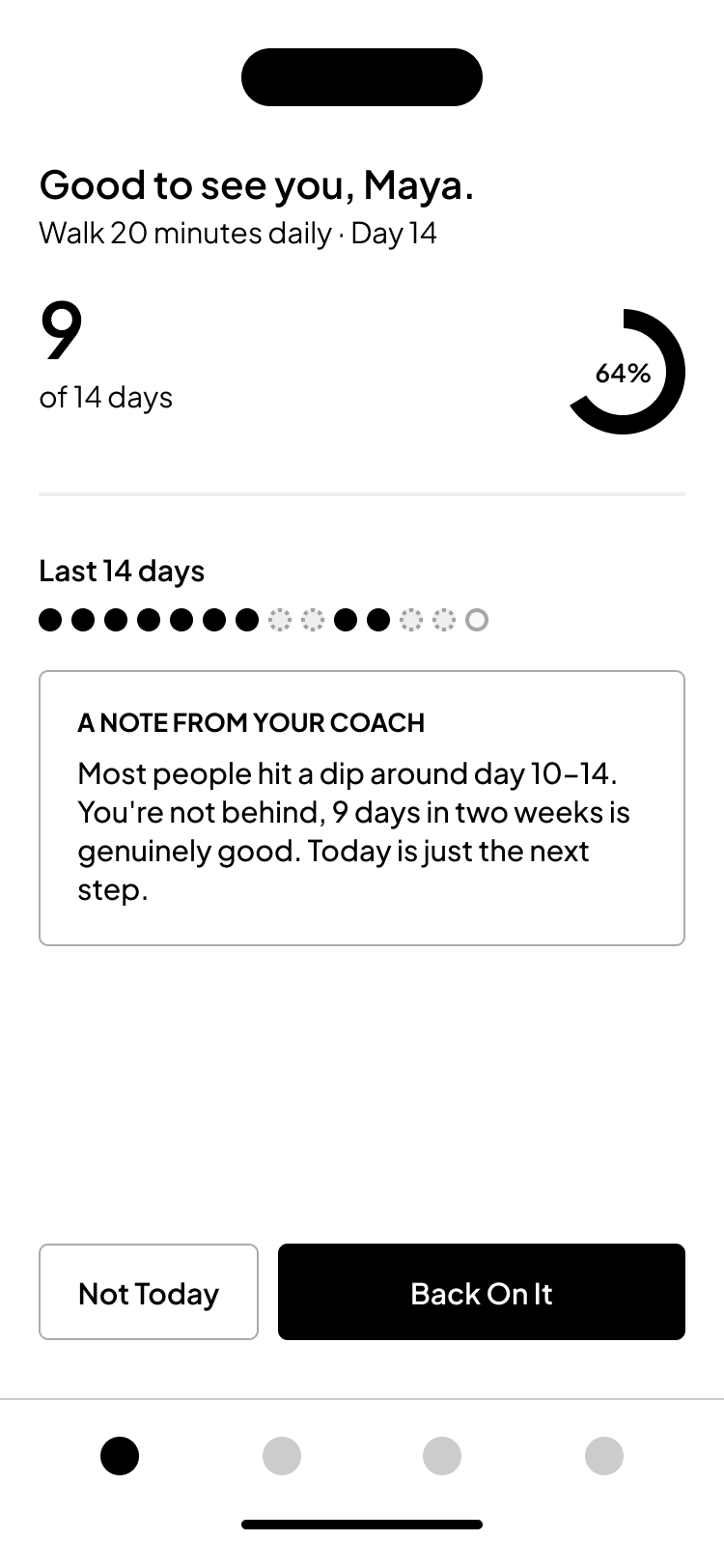
Setback moment. Reframe, not guilt. "Back on it" primary CTA. Coach note replaces insight box. Dashed dots signal a missed day without punishing.
Screen 06
Progress view — Day 30
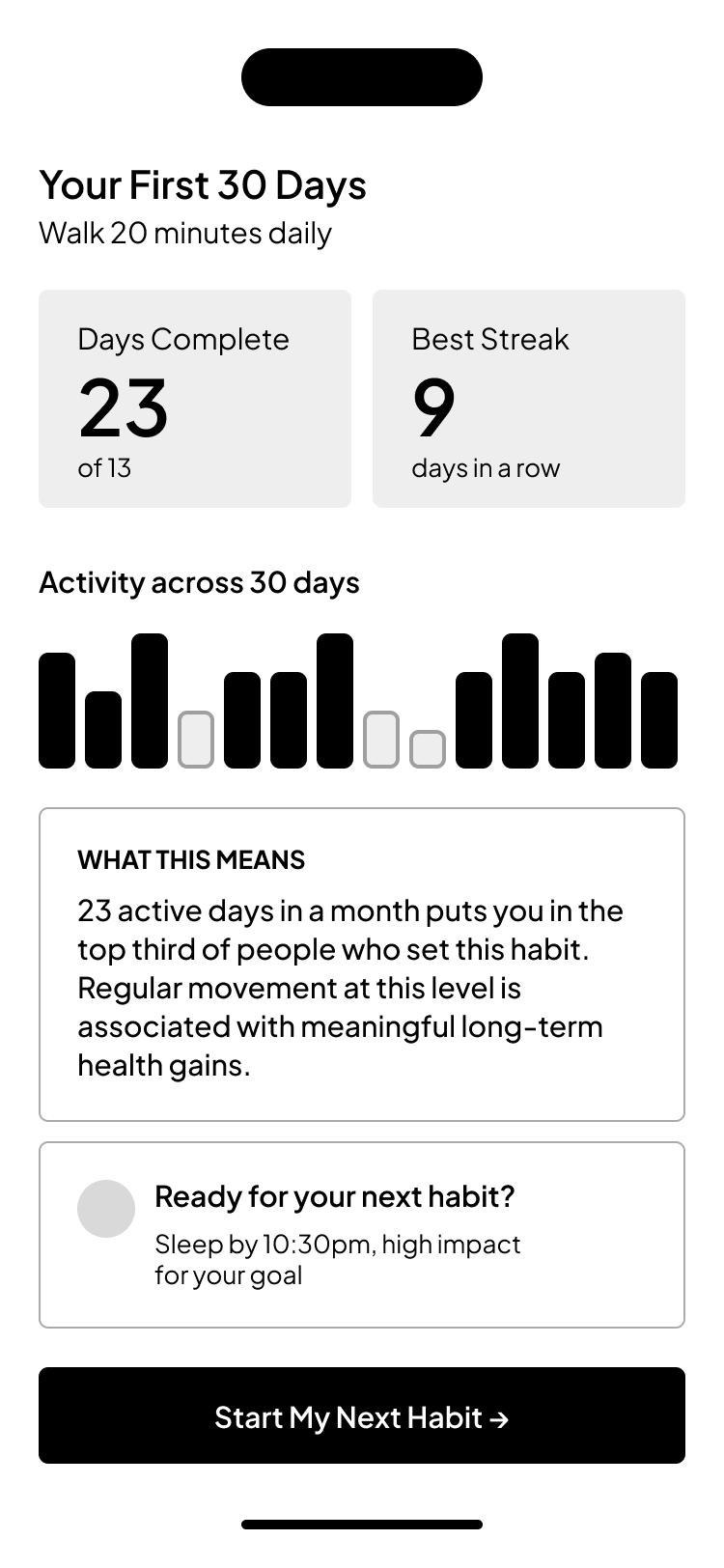
Earns the celebration. 30-day arc visible. Connects habit consistency to the member's stated goal. Introduces next chapter from existing shortlist.
In scope — v1
✓Onboarding & goal setting
✓Daily habit check-in
✓Progress visualisation
✓Key moment states (setback, milestone)
✓One pixel-precise UI surface
Out of scope — v1
✗GP referrals or clinical data
✗Nutrition tracking
✗Wearable device integration
✗Social comparison by default
✗Multi-market localisation
Categories
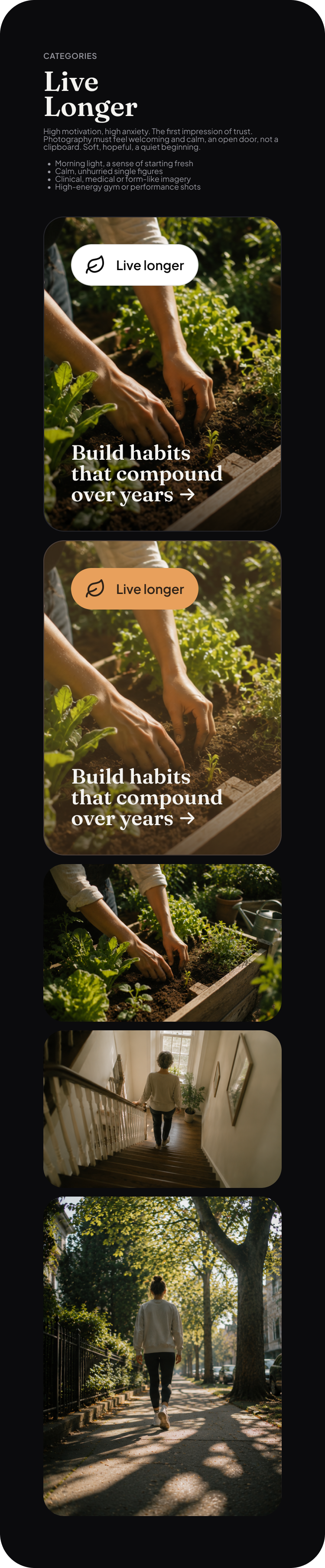
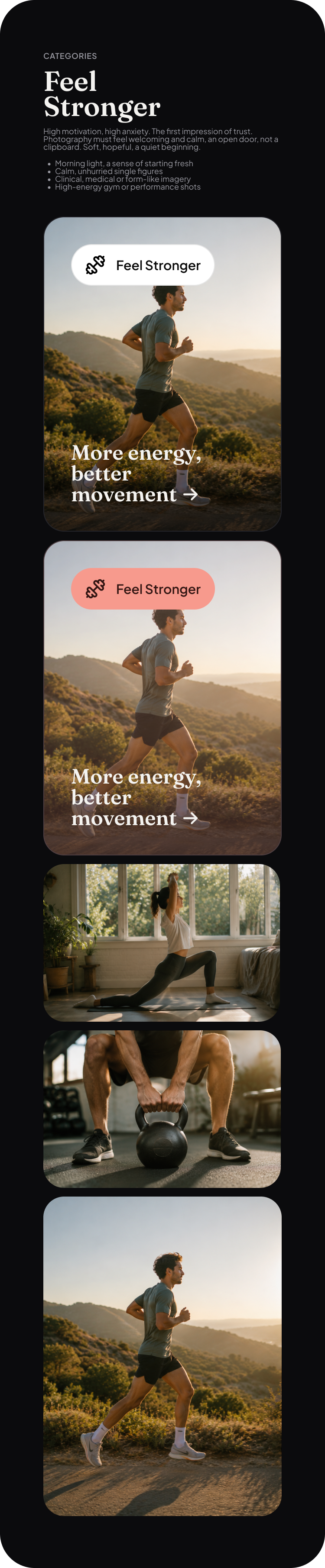
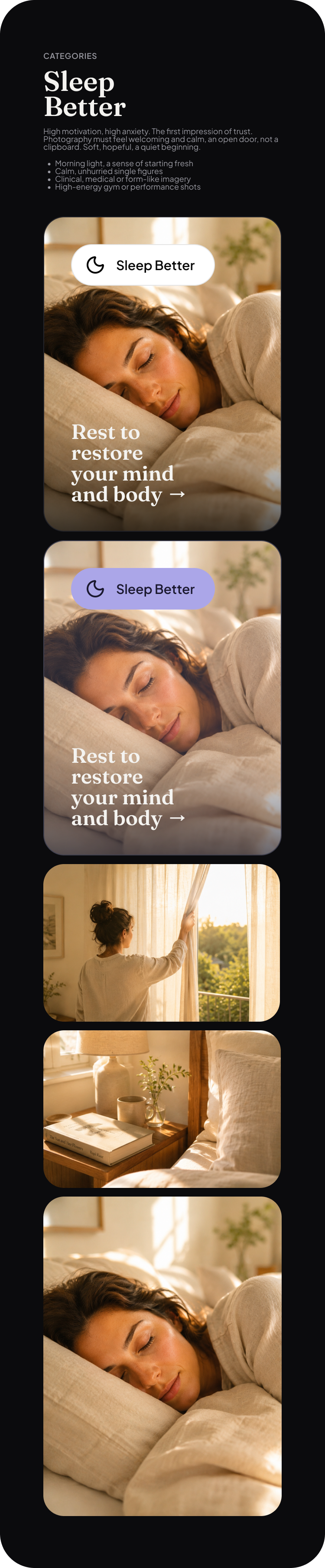
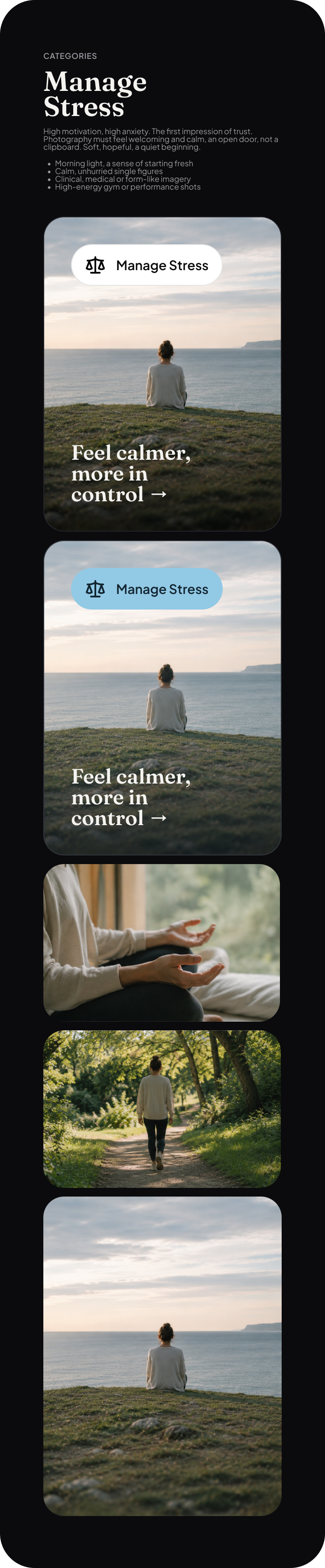
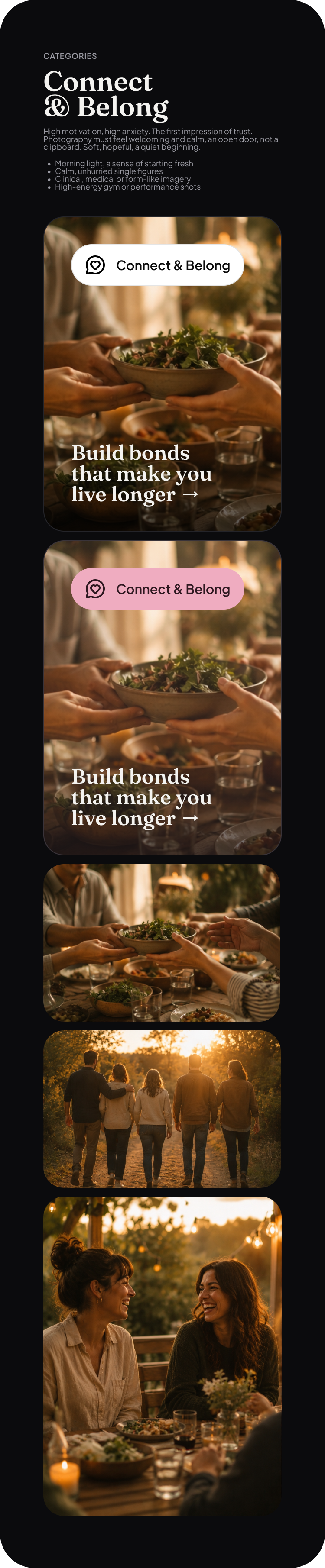
Five goal categories — each with a distinct visual identity, colour and photography direction that carries through the app.
Category 01
Live Longer
Category 02
Feel Stronger
Category 03
Sleep Better
Category 04
Manage Stress
Category 05
Connect & Belong
03 — Habit Library
19 habits across 5 categories
Consolidated from Blue Zones (Dan Buettner) and Blueprint (Bryan Johnson). Each habit with source, description, and club/app context. Six are the onboarding shortlist — the habits London Health should offer on day 1.
Blue Zones
Blueprint
Both sources
Movement
Walk 20+ minutes daily
Both
Natural movement embedded in daily life. Linked to 30% lower early mortality risk. The single most accessible longevity habit.
club: outdoor routesapp: step tracking
Strength train 2–3× per week
Blueprint
Preserves muscle mass and metabolic health with age. Compound movements (squat, hinge, push, pull) deliver the most return.
club: gym floor, PTapp: workout log
Cardio 3× per week
Blueprint
Zone 2 cardio (conversational pace) improves VO2 max, heart health and mitochondrial density — all key longevity markers.
club: pool, classesapp: session log
Take the stairs, walk the short trip
Blue Zones
Environmental nudges that embed movement without effort. Blue Zones communities don't exercise — they move constantly.
app: active minutes
Sleep
Sleep 7–8 hours nightly
Both
The most impactful single health behaviour. Affects inflammation, cognitive function, metabolic health and emotional regulation simultaneously.
app: sleep score
Consistent sleep and wake time
Blueprint
Circadian rhythm consistency improves HRV, sleep quality and daytime energy — even when total hours are the same.
app: bedtime reminder
No screens 30 min before bed
Blueprint
Blue light suppresses melatonin. Swapping screens for reading, stretching or stillness meaningfully improves sleep onset.
app: wind-down prompt
Afternoon rest or nap (10–20 min)
Blue Zones
Practiced in Ikaria and Sardinia. Short naps reduce cardiovascular risk and restore afternoon alertness without disrupting night sleep.
app: rest reminder
Nutrition
Eat one plant-based meal daily
Blue Zones
Plant diversity drives gut microbiome health, reduces inflammation and is the common nutritional thread across all five Blue Zones.
club: café menuapp: meal log
Stop eating at 80% full
Blue Zones
Hara hachi bu — the Okinawan practice of eating until just satisfied. Naturally reduces caloric intake without tracking or restriction.
app: mindful eating prompt
Avoid ultra-processed food
Blueprint
UPF consumption is strongly linked to early mortality. Building food systems (meal prep, default choices) beats willpower every time.
app: nutrition guide
Eat with others when possible
Blue Zones
Communal eating slows pace, reduces portion size and strengthens social bonds — all independently associated with longevity.
club: café, social space
Stress & Mental Wellbeing
5 minutes of stillness daily
Both
Meditation, breathing or quiet reflection. Reduces cortisol, lowers resting heart rate and improves HRV over time. The most accessible stress habit.
club: studio, quiet spaceapp: guided breathing
Daily downshift ritual
Blue Zones
A consistent transition between work and rest — walk, prayer, conversation, bath. Signals safety to the nervous system and discharges accumulated stress.
app: evening check-in
Spend time in nature weekly
Blue Zones
Green space exposure reduces cortisol, blood pressure and anxiety. Even 20 minutes produces measurable physiological change.
app: outdoor activity log
Community & Purpose
Nurture 3–5 close relationships
Both
Social connection is as protective as not smoking. Loneliness increases mortality risk by 26%. Moai — Okinawan social groups — are a structural solution.
club: group classes, events
Have a defined sense of purpose
Both
Ikigai (Okinawa) or plan de vida (Nicoya). People with strong purpose live 7 years longer on average. Purpose can be set and practised, not just discovered.
app: goal setting
Contribute to something beyond yourself
Blue Zones
Volunteering, mentoring, caring for others. Altruistic behaviour is independently associated with longer life and reduced depression.
app: reflection prompt
Belong to a community or group
Blue Zones
Faith communities, clubs, shared-interest groups. Attending even monthly reduces mortality risk. The mechanism is social accountability and belonging.
club: classes, membership
04 — Design System
Tokens & craft
A minimal token set built before any HiFi screen — colour, typography, spacing, radius and components, all calibrated to the London Health brand.
type/heading-sm · 14px · 700 · habit name, card title
Based on your goal: live longer. Each of these habits has strong longevity evidence behind it.
type/body · 12px · 400 · lh 1.6 · insight text
Today's insight
type/eyebrow · 10px · 700 · uppercase · 0.08em
Done it
type/button · 12px · 700 · all button labels
Today · Progress · Habits · Profile
type/nav · 9px · 600 · bottom nav
Category colour system
Live Longer
Vital red #E10A0A — action, energy, intent
Feel Stronger
Warm oak #8B5E3C — physical strength, grounded
Sleep Better
Living green #4A7C59 — restoration, growth
Manage Stress
Sage #A8C5A0 — calm, fresh, delicate
Connect & Belong
Purple #7F77DD — depth, community, belonging
Spacing — base 4px
space/1 · 4pxIcon-to-label gap, dot gap
space/2 · 8pxBetween label and value
space/3 · 12pxCard internal gap
space/4 · 16pxScreen horizontal padding
space/5 · 20pxBetween habit cards
space/6 · 24pxBetween heading and first block
Button height · 44pxPrimary and secondary CTAs
Nav bar height · 56pxBottom navigation
Ring / avatar · 52pxProgress ring diameter
Dot size · 12pxStreak / arc dots
Radius & border
radius/sm · 4pxBar chart bars
radius/md · 8pxInsight box, stat cards
radius/lg · 12pxHabit cards, goal chips
radius/pill · 24pxButtons, step pill
radius/circle · 50%Streak dots, avatar, ring
radius/phone · 20pxPhone frame outer border
border/default · 1pxHabit cards, insight box
border/selected · 1.5pxSelected habit card, chip
border/divider · 0.5pxSection dividers, nav top
border/dot-miss · 1.5px dashedMissed day dots
05 — Visual Design
High-fidelity screens
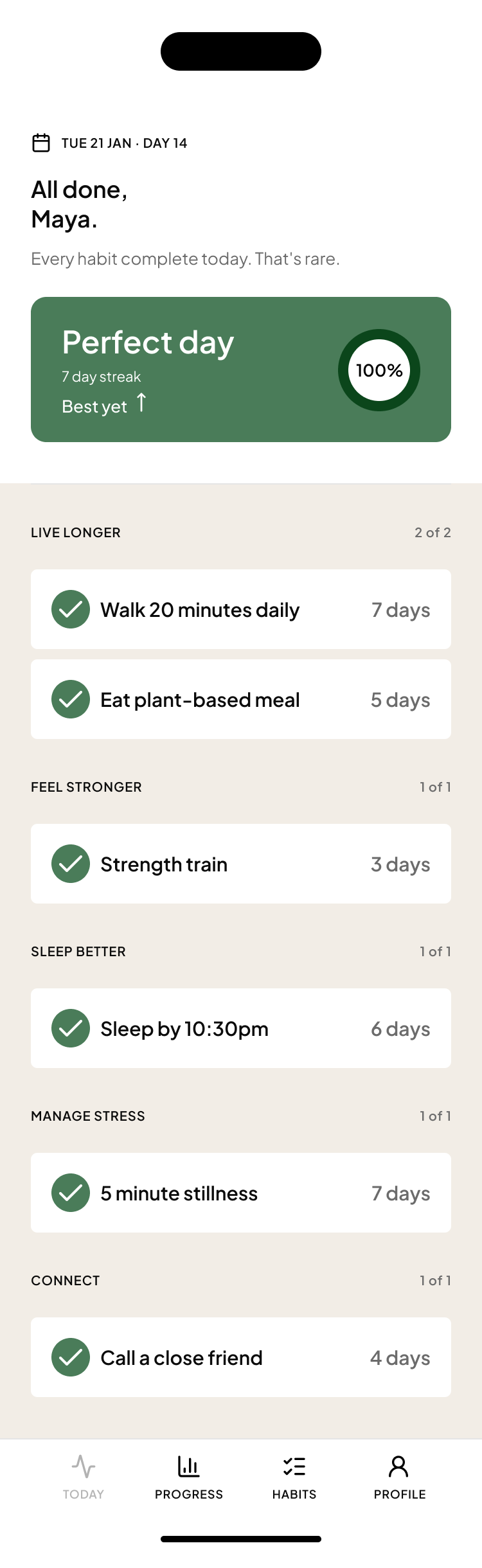
Screens 4a and 4b are the HiFi centrepiece — same layout, same two-button structure, everything shifts: tone, copy, dots, ring fill, and the insight box. The contrast tells the full design story.
Data capture
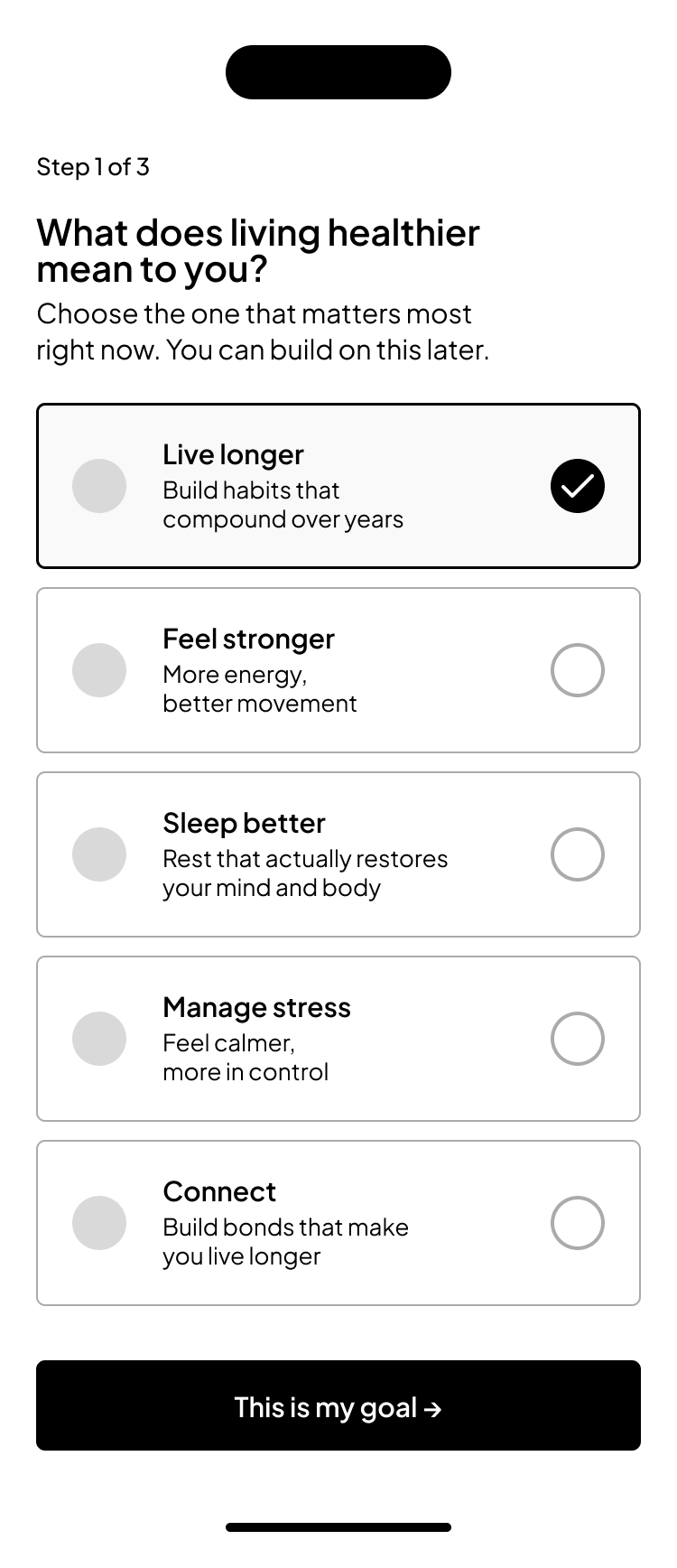
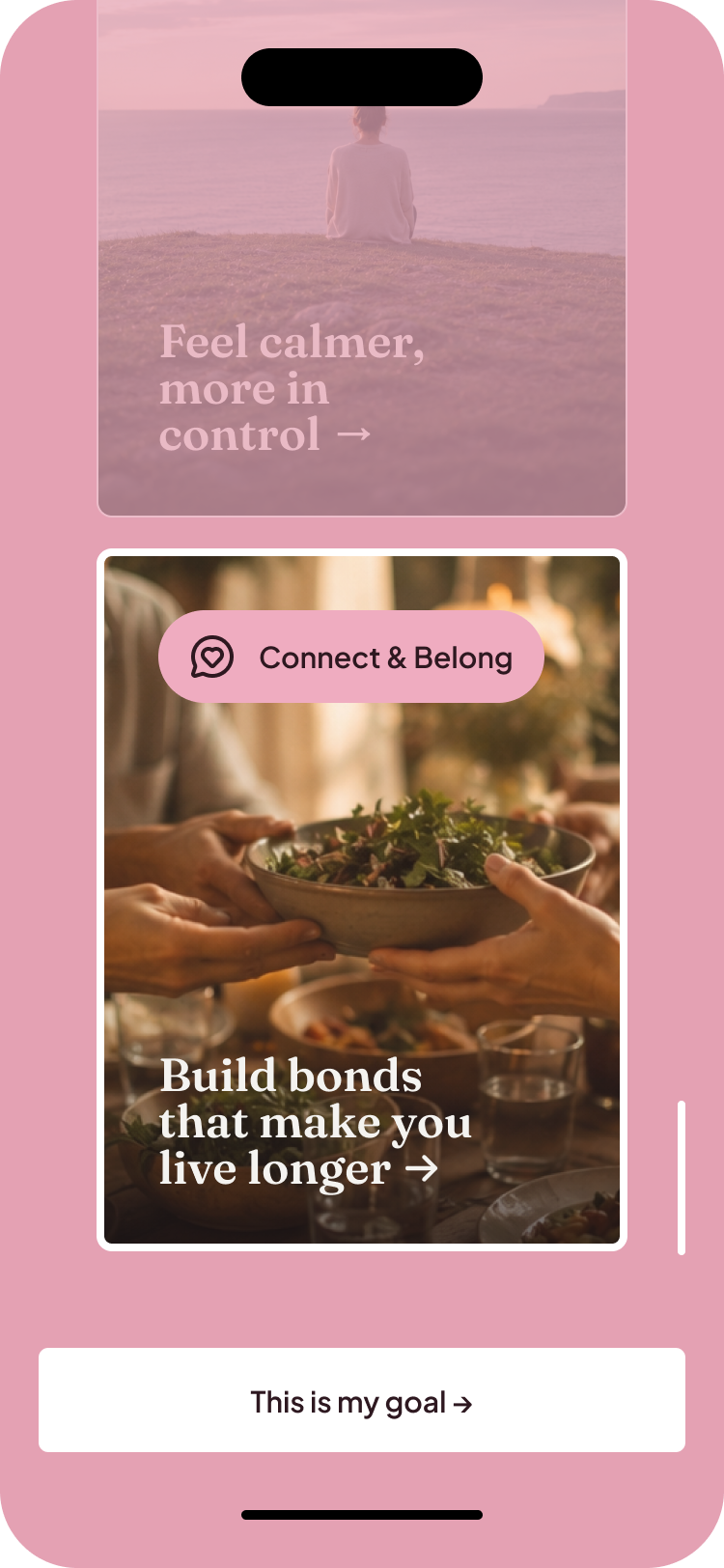
Goal selection — the first screen a member sees. Each category carries its colour and photography into the selection UI, making the choice feel personal rather than clinical.
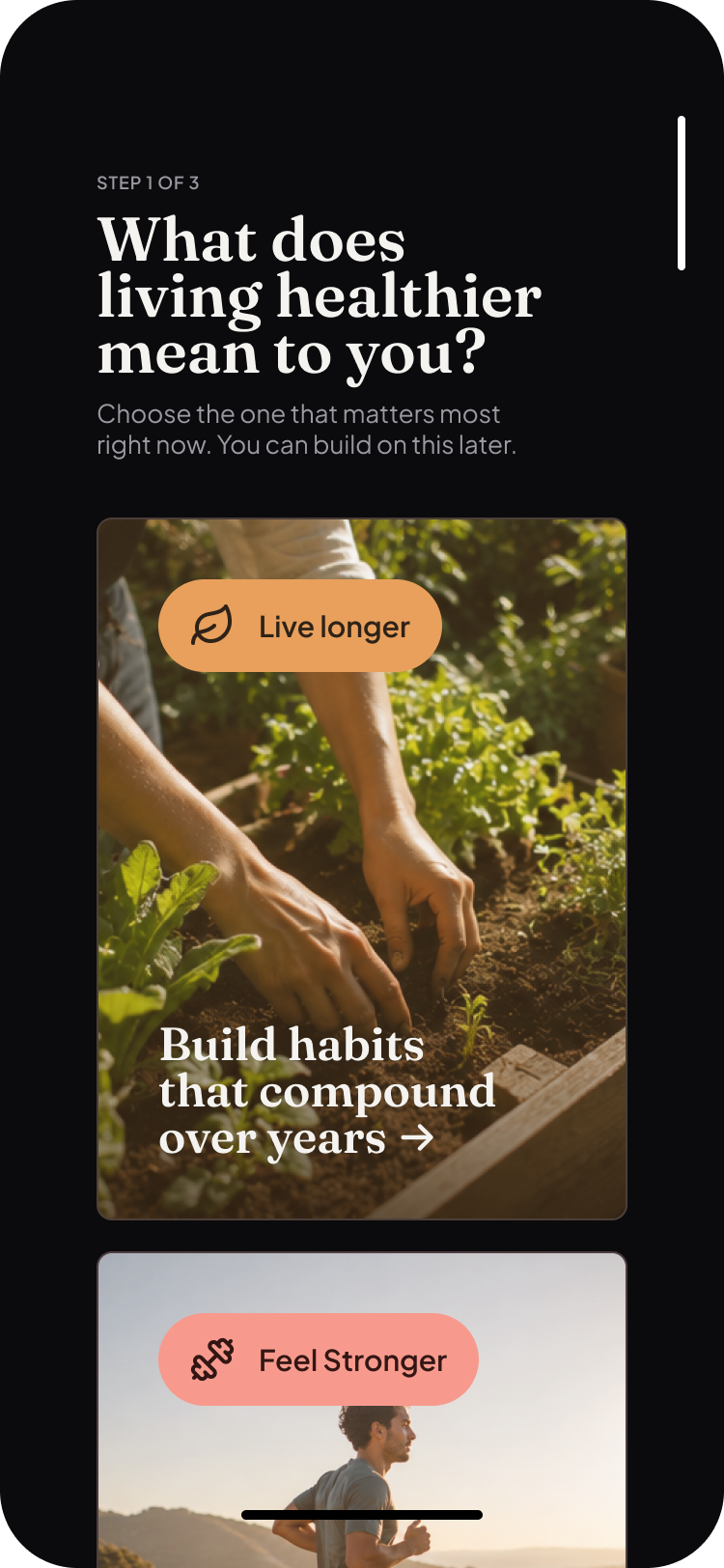
Screen 01
Goal selection — dark
Dark mode entry state. Category tiles invite selection. Colour hierarchy first — name appears after touch.
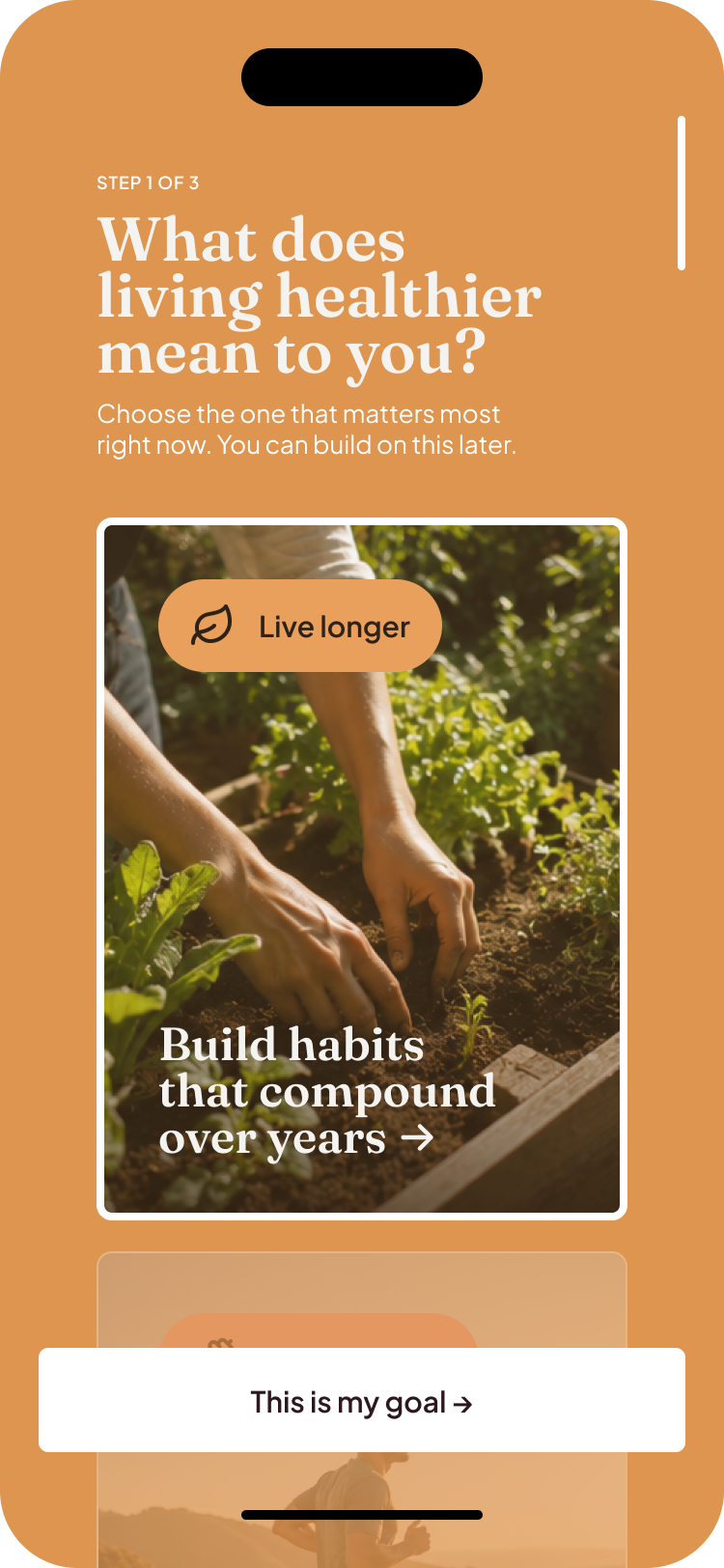
Screen 02
Goal selection — Live Longer
Activated state. Orange palette carries through from category. Photography previews the feeling, not the metric.
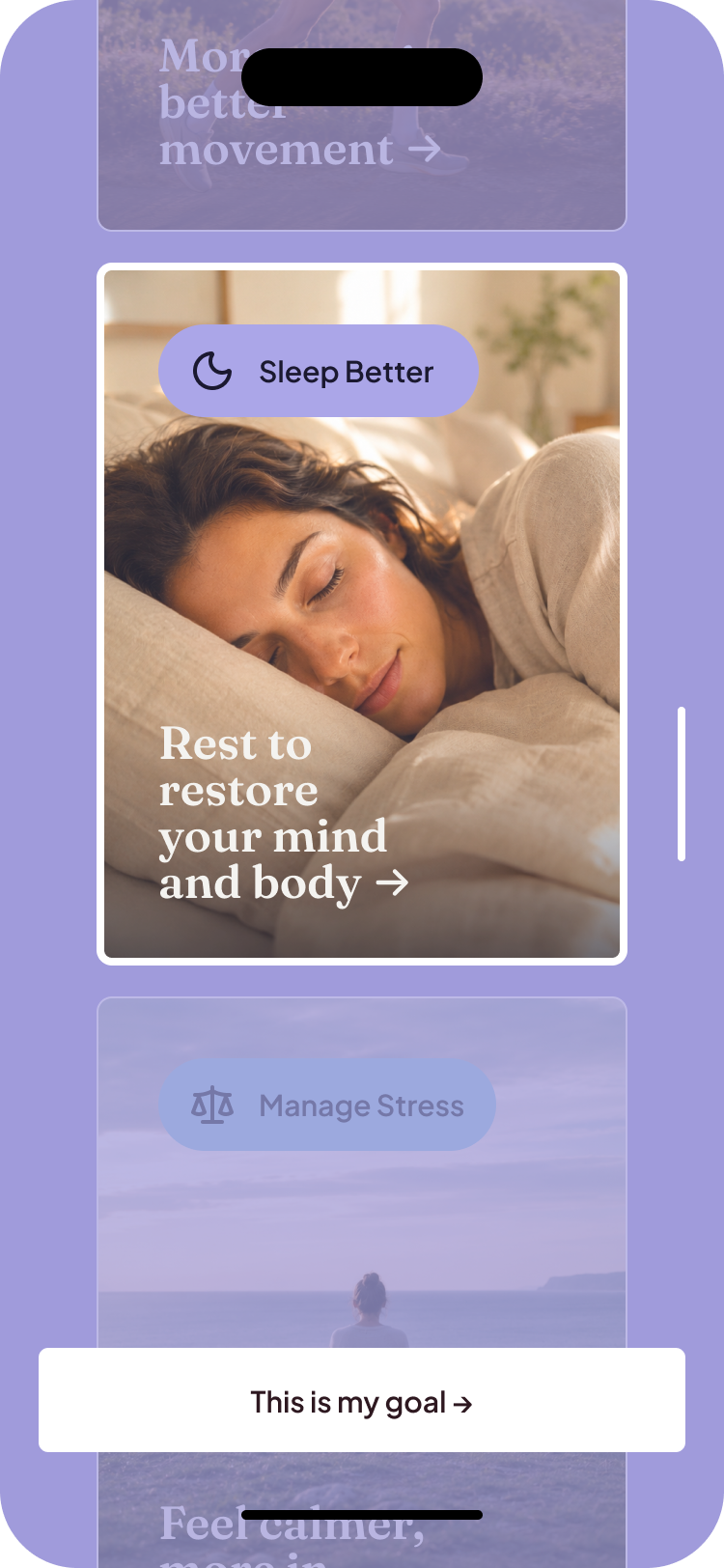
Screen 03
Goal selection — Sleep Better
Purple calm palette. Each goal has a distinct visual identity that makes the selection feel intentional.
Screen 04
Goal selection — Connect & Belong
Pink depth. Same layout, entirely different mood — the system adapts without a mode switch.
Dashboard
Progress views — how the app surfaces habit consistency over time. Each variant shows a different member and habit context, demonstrating the system's flexibility across personas and categories.
Screen 01
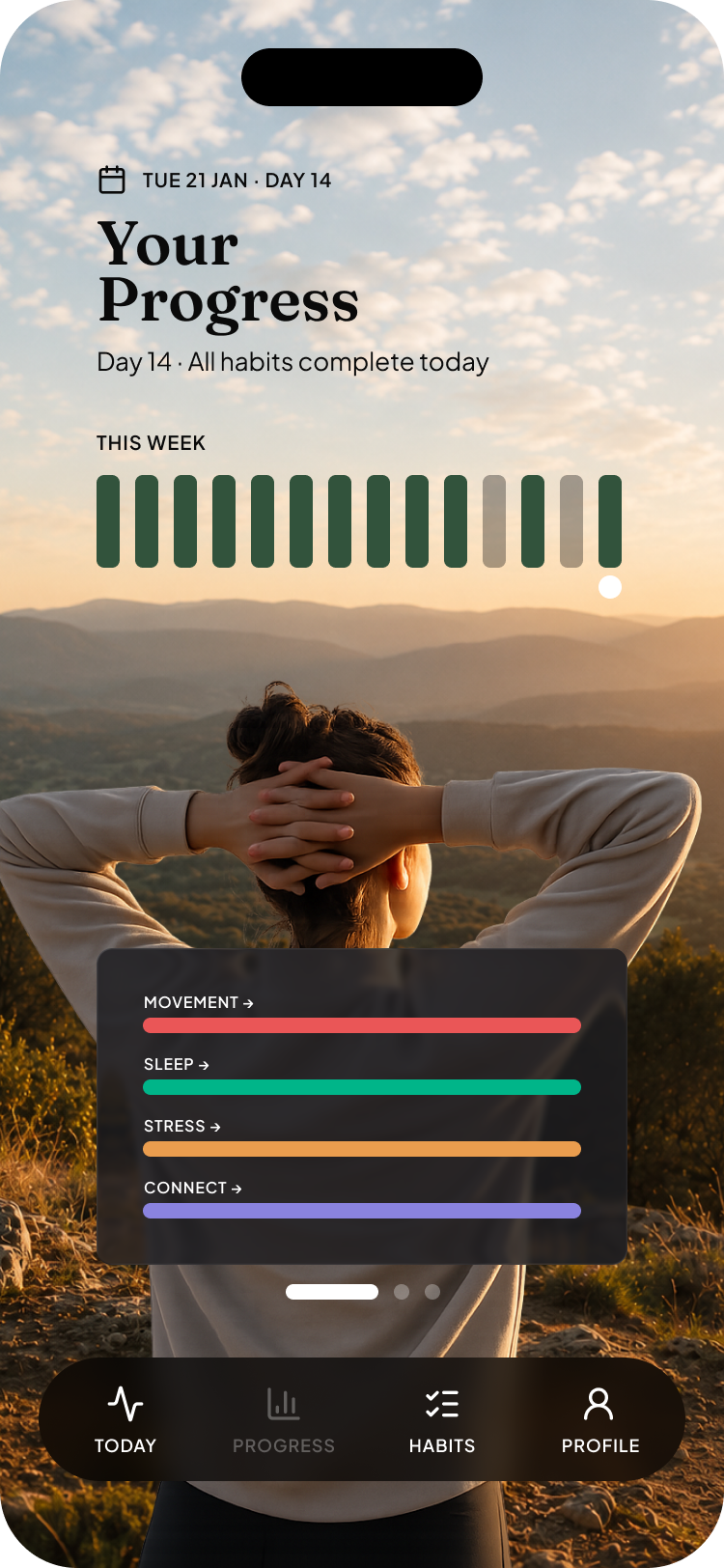
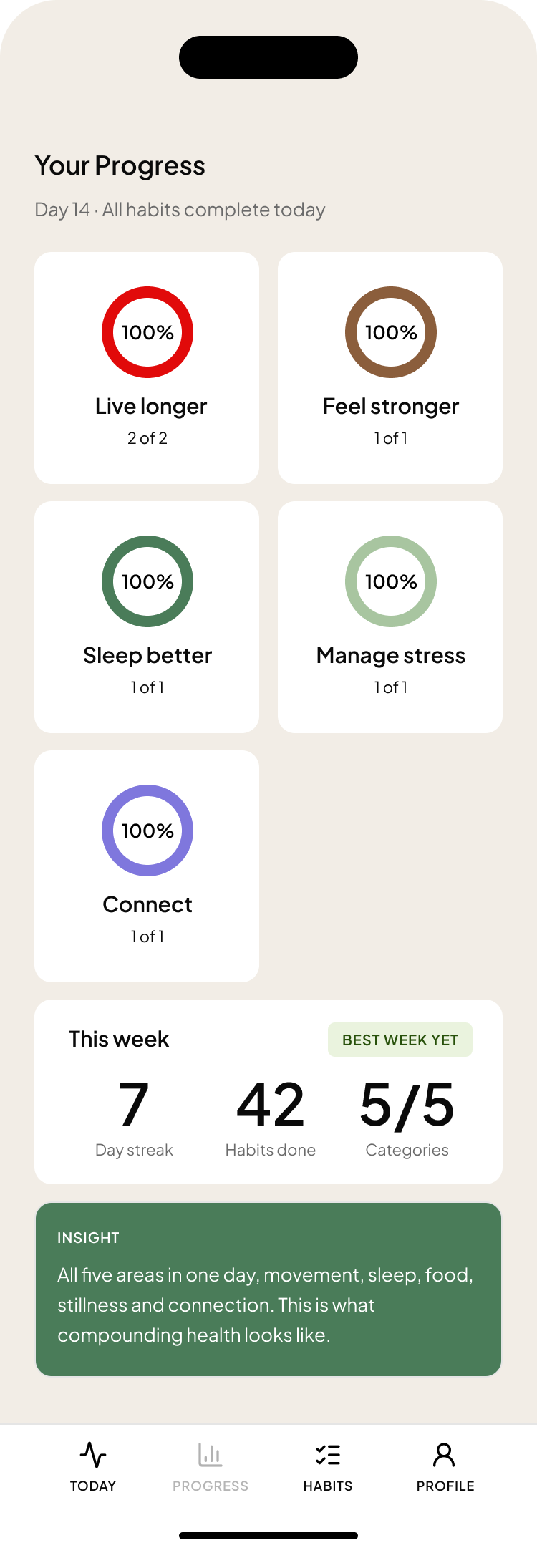
Your Progress — weekly
Maya, Day 7. Progress ring at 100%. Streak dots filled. Insight earned through consistency.
Screen 02
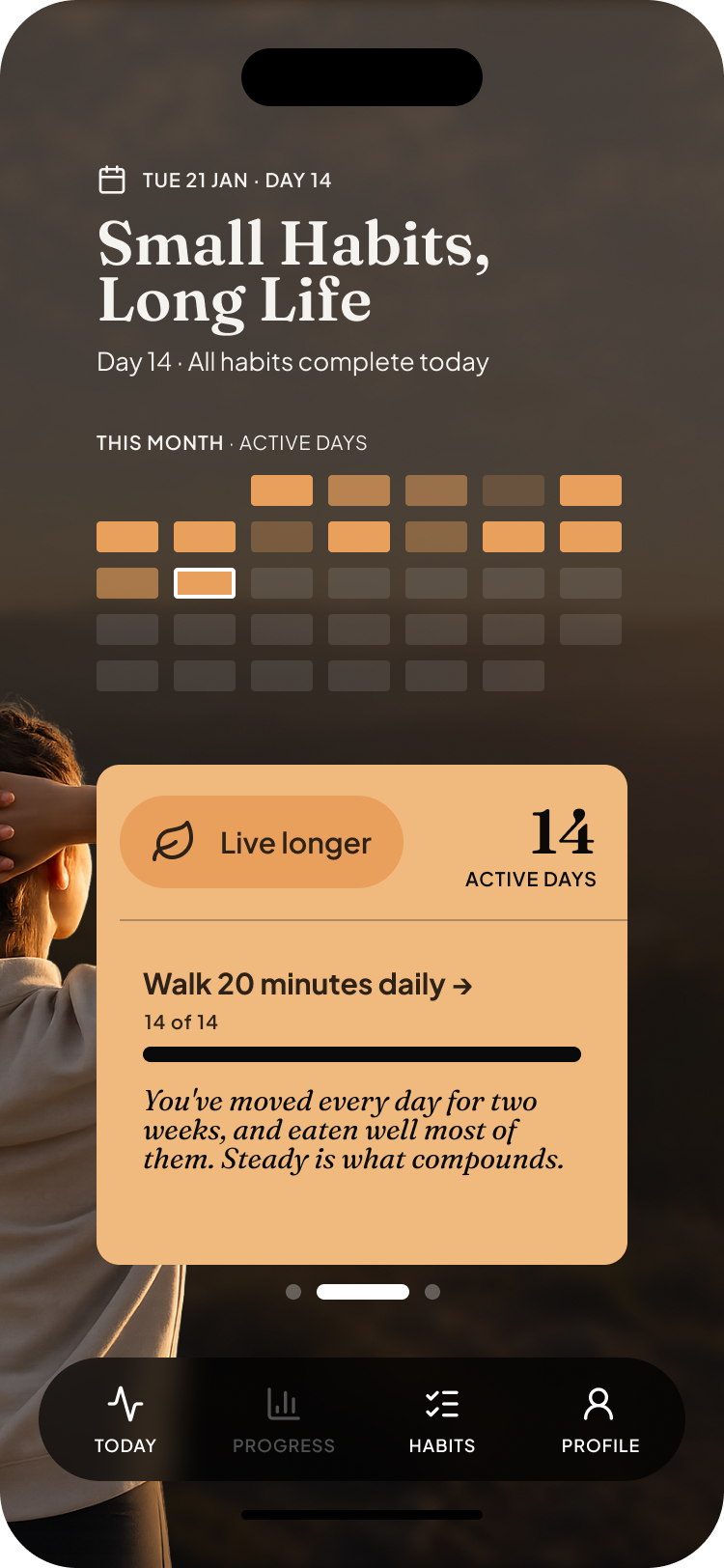
Small Habits, Long Life — monthly
Monthly arc. Dots span 30 days. Habit consistency mapped against the member's stated longevity goal.
Screen 03
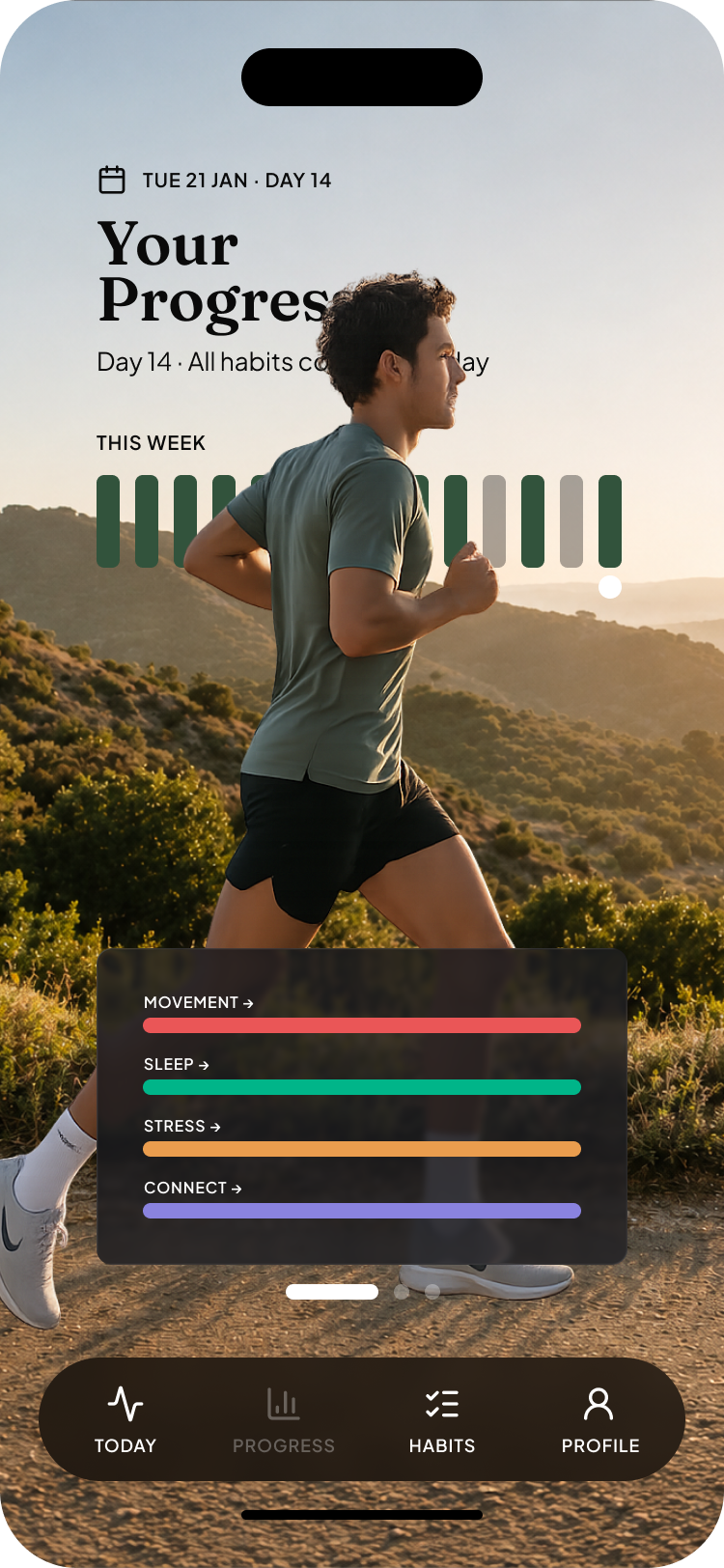
Your Progress — male
James — same interaction model, different context. The system adapts without a mode switch.
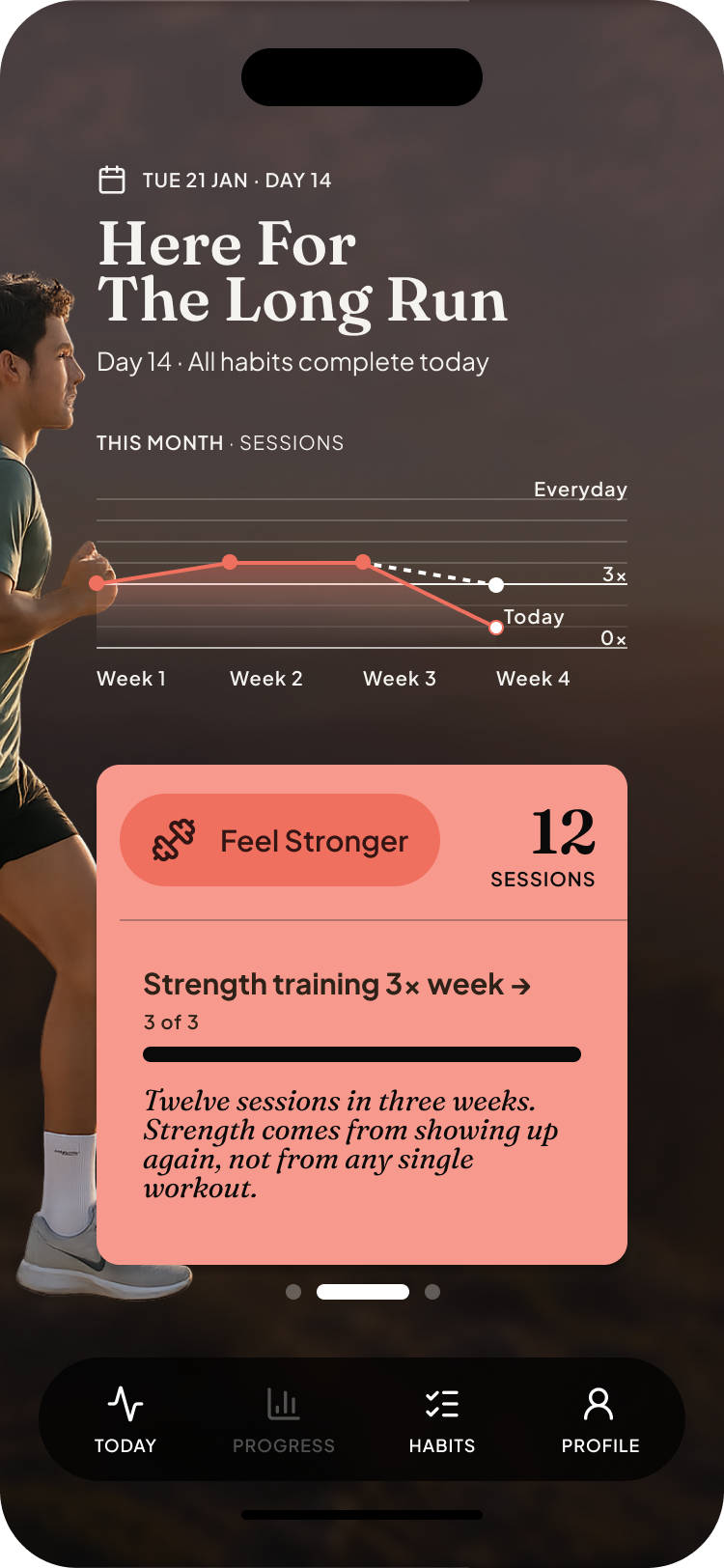
Screen 04
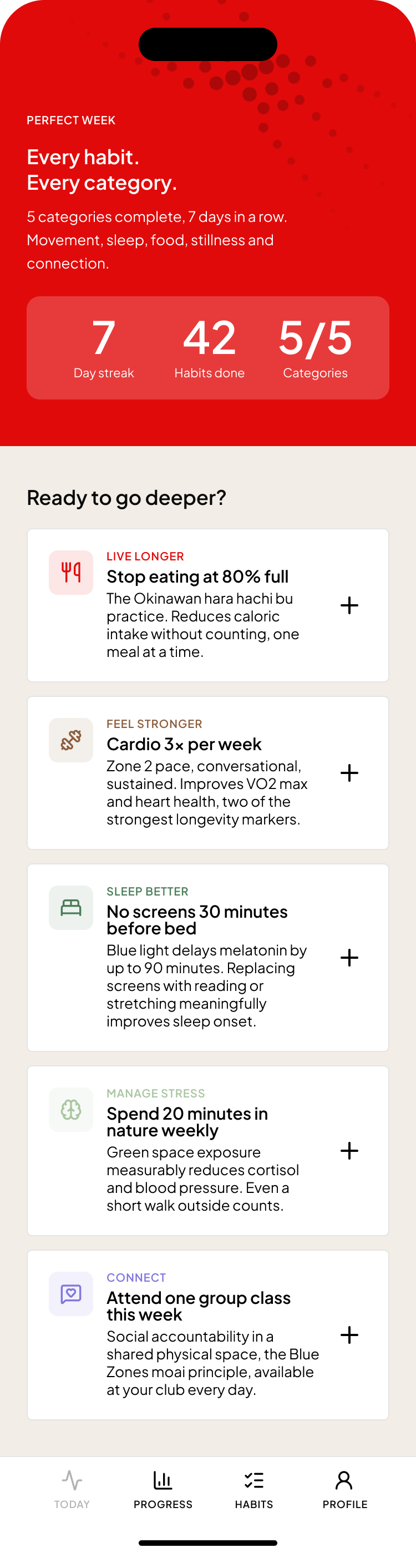
Here For The Long Run
Milestone reached. Dashboard surfaces the 30-day arc as a complete story, not a raw metric.
Design decision
The setback moment (Day 14) is the most underdesigned moment in health apps. Getting the reframe right is the product's biggest differentiator.
Behaviour insight
Dashed dots signal a missed day without punishing. Present, but not permanent. The three-way dot system (filled / dashed / empty) is one of the most considered details in the design.
Trust principle
Insights use qualified language — "linked to a 30% lower risk" not "you will live longer." Trust is built through restraint: saying less, more accurately.
06 — What's Next
Next Steps
Three areas for v2 and open questions that discovery didn't answer, but a live product must.
v2 · 01
Third party integration
Connect sleep, HRV and activity data from Apple Watch or Oura to enrich the progress view with passive data — reducing the check-in burden for engaged members like James.
v2 · 02
Habit library expansion
Grow the curated habit set beyond movement — into sleep, nutrition, stress and community. Introduce a second habit at day 30 based on the member's first-habit performance.
v2 · 03
Community & social layer
Optional shared goals and club-level challenges — connecting the digital habit experience back to the physical club. Anchored in the Blue Zones community principle.
Open questions
How do we validate the habit model with real member data before scaling?
What is the right moment to introduce a second habit — and how do we avoid overwhelm?
How does London Health evolve from a habit tracker into a longevity companion over 12 months?
How do we localise the experience across international markets without losing coherence?
Next Steps
Ask Us Anything
I’d welcome the chance to talk through how I can help.